
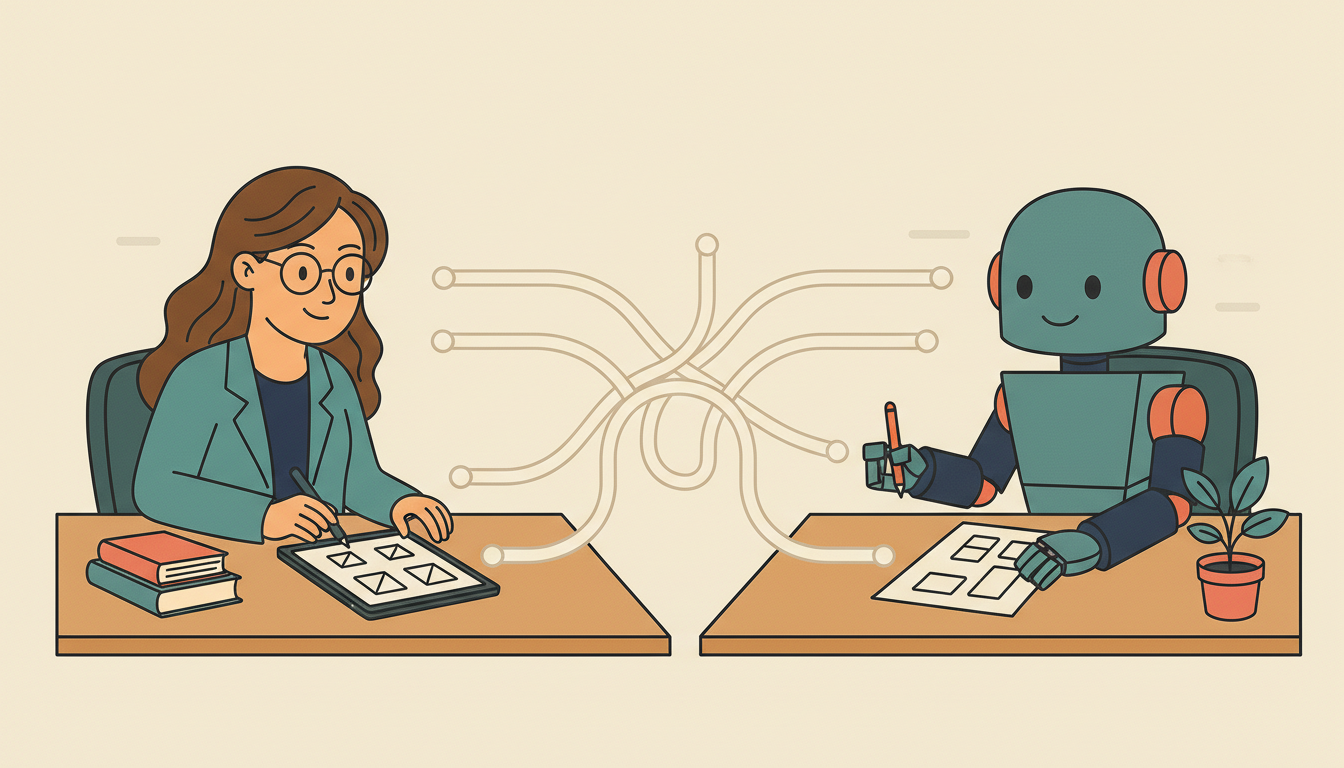
Every few months, a new AI tool drops and the design internet loses its collective mind. Half the comments are victory laps about the death of designers. The other half are defensive threads about how creativity can never be automated. Both sides are wrong, and both are missing the point entirely.
I've been in web design for 24 years. I hand-coded HTML in the early 2000s. I rode the WordPress wave. I built Elementor systems at scale. And now I use Claude Code every single day to build static sites and design systems faster than I ever have. I'm not writing this from the sidelines. I'm writing it from inside the machine, literally, with tools that didn't exist eighteen months ago.
And I'm telling you: AI is not coming for your job. But it is coming for the parts of your job you were already doing badly.
The panic is real. The framing is wrong.
I get the fear. I genuinely do. When you watch an AI tool generate a passable landing page in thirty seconds, it's hard not to feel a chill. When a client asks why they need to pay you when they can "just use ChatGPT," the anxiety is rational.
But the fear is pointed at the wrong target. The threat isn't that AI can do what great designers do. It can't. The threat is that AI can do what mediocre designers do — and it can do it faster, cheaper, and without needing a Slack channel.
If your entire value proposition as a designer is assembling pre-made components, following trends, and making things look "clean," you have a problem. Not because AI is new, but because that was never really design in the first place. It was production work wearing a designer's title. And production work is exactly what automation eats first.
What AI is genuinely good at right now
I'm not interested in hype or hypotheticals. Here's what AI actually does well in my daily workflow — today, not in some imagined future:
First drafts of copy. I can feed AI a brief, a brand voice guide, and a page structure, and get back serviceable first-draft copy in minutes. It's never final. It always needs editing. But it eliminates the blank page problem, and that alone saves hours per project.
Code scaffolding. I use Claude Code to generate component structures, write CSS from design specs, and build page layouts. It handles the repetitive structural work so I can focus on the decisions that actually matter — the spacing relationships, the interaction patterns, the responsive behavior that requires human judgment.
Pattern research. Need to see how twenty SaaS companies handle their pricing page? AI can analyze patterns, summarize approaches, and surface insights faster than I can open twenty browser tabs. It's a research accelerator, not a research replacement.
Repetitive production tasks. Alt text generation. Meta description drafts. Resizing assets. Generating color variations. The tasks that eat your afternoon without engaging your brain — AI handles those brilliantly.
Brainstorming and ideation. When I'm stuck on a concept direction, having a tool that can rapidly generate thirty variations of a headline or explore five different structural approaches for a page gives me raw material to react to. My job becomes curation and refinement rather than generation from zero.
What AI is terrible at
Here's the part the hype cycle conveniently ignores:
Taste. AI can generate a thousand options. It cannot tell you which one is right. It has no aesthetic judgment, no sense of restraint, no understanding of when something is "too much" or "not enough." Taste is pattern recognition refined by decades of seeing what works, what fails, and — critically — understanding why. AI doesn't have a why.
Strategy. AI doesn't know that your client's real problem isn't a new homepage — it's that their sales team doesn't follow up on leads, and the website redesign is a distraction from fixing the actual bottleneck. Strategy requires understanding the business, the politics, the things nobody says out loud. No model has that context.
Knowing when to break the rules. Every design principle has exceptions. Sometimes you should break the grid. Sometimes the "wrong" font choice is the right one. The best design work lives in the tension between rules and intuition, and AI only knows rules.
Empathy at scale. AI can analyze user data. It cannot sit across from a frustrated user and watch their face as they try to complete a task. It cannot feel the difference between "this works" and "this feels right." User empathy isn't data interpretation — it's a human skill that gets deeper with experience.
Client relationships. Half of design is navigating the conversation around design. Reading the room in a stakeholder review. Knowing when to push back and when to compromise. Understanding that when a client says "make it pop," they're really saying "I'm not confident this will work and I need reassurance." AI has no relational intelligence whatsoever.
AI is an extraordinary tool for execution. It is a terrible tool for judgment. And design, at its core, is judgment.
The "lazy designer" problem
Let me be direct about who is actually at risk here, because the conversation keeps getting muddied by vague reassurances.
If you've spent your career following templates, chasing trends, and treating design as a visual production task — yes, AI threatens your position. Not because AI is brilliant, but because the work you were doing never required brilliance. It required competence with tools, a decent eye, and enough trend awareness to keep things current. AI can do all of that now.
The designers I'm not worried about are the ones who:
- Can articulate why a design decision serves the business goal
- Think in systems, not screens
- Understand that a beautiful interface that doesn't convert is a failure
- Can translate ambiguous stakeholder feedback into actionable direction
- Treat research as a foundation, not a checkbox
- Know the difference between personal preference and effective design
These people aren't threatened by AI. They're amplified by it. They now have a tireless assistant that handles the production work so they can spend more time on the thinking that actually creates value.
The gap between "designer as pixel pusher" and "designer as strategic thinker" has always existed. AI just made it impossible to ignore.
How I actually use AI (the real workflow)
I'm not theorizing here. This is what my actual process looks like on a client project right now:
Discovery and research: I use AI to analyze competitor sites, summarize industry patterns, and draft initial content structures. This cuts my research phase from days to hours — but I still make every strategic decision myself. The AI surfaces information. I decide what matters.
Content and copy: AI generates first-draft copy based on brand guidelines and page goals. I rewrite 60-70% of it. The AI gets the structure and direction close; the voice, nuance, and strategic emphasis are mine.
Design and prototyping: I design in my head and on paper, then use Claude Code to build HTML prototypes directly — the site you're reading this on was built this way. The AI writes the code. I direct every design decision — the spacing, the typography scale, the interaction patterns, the responsive behavior. It's like having a very fast junior developer who never gets tired and never pushes back on a revision.
Production and optimization: Alt text, meta descriptions, accessibility checks, performance optimization — AI handles the systematic stuff. I review and refine, but the heavy lifting on repetitive tasks is automated.
Notice the pattern: AI does the labor. I do the thinking. The combination is faster than either one alone. But remove the human judgment, and what you get is technically competent mediocrity — fast, efficient, and completely forgettable.
The skills that matter more now
If AI handles execution, the premium shifts entirely to the skills that sit above execution. Here's what I'd invest in if I were building a design career today:
Systems thinking. The ability to see how individual components connect to form a coherent whole. To understand that a button change here affects a flow there, which impacts a metric over there. AI generates parts. Designers who think in systems build things that actually work together.
Communication. The ability to present work, defend decisions, translate between stakeholders, and write clearly. Every AI tool still needs a human who can articulate the brief, frame the problem, and explain the solution. If you can't communicate your thinking, your thinking doesn't matter.
Strategic framing. The ability to look at a design request and ask "is this actually the right problem to solve?" Before a single pixel exists. Before AI generates anything. The most valuable thing a designer does is point the work in the right direction. Everything downstream of that — including the AI-assisted execution — depends on that initial framing.
Taste and curation. When AI can generate unlimited options, the person who can look at a hundred possibilities and pick the three that actually work becomes invaluable. Taste isn't subjective whimsy — it's informed judgment built over years of practice. And it's the one thing that gets more valuable as generation becomes trivially easy.
The honest part nobody wants to say
AI is changing the design profession. Meaningfully. Permanently. And pretending otherwise is naive.
Some jobs will disappear. Junior production roles that were primarily about execution — resizing, asset creation, template assembly — will shrink. That's not a maybe. It's already happening.
Project timelines are compressing. What took two weeks now takes four days. Clients will expect that pace. Budgets will adjust. The economics of design work are shifting, and "but it takes time to do it right" becomes a harder argument when AI demonstrably compresses the mechanical parts of the work.
The designers who thrive will be the ones who adapt. Not by learning every new AI tool (they change too fast for that to be a strategy), but by doubling down on the human skills that AI can't replicate. Strategy. Judgment. Empathy. Taste. The ability to ask the right questions before generating any answers.
The designers who struggle will be the ones who either refuse to use AI at all (leaving speed and efficiency on the table) or who delegate their entire process to AI (producing work with no human judgment in it). Both extremes lose.
The winning position is neither resistance nor surrender. It's integration — using AI as a power tool while keeping human judgment at the center of every decision that matters.
I've been in this industry long enough to have worked through table-based layouts, the CSS revolution, the mobile-first shift, responsive design, the WordPress era, and now the AI wave. Twenty-four years of watching the same pattern: the tools change, the craft evolves, and the people who were relying on the old tools instead of developing real skills are the ones who get left behind.
AI won't replace designers. But it will absolutely, mercilessly replace the ones who were never really designing in the first place.
Sharpen the skills that matter. Use the tools that help. And do the work that only a human can do.