
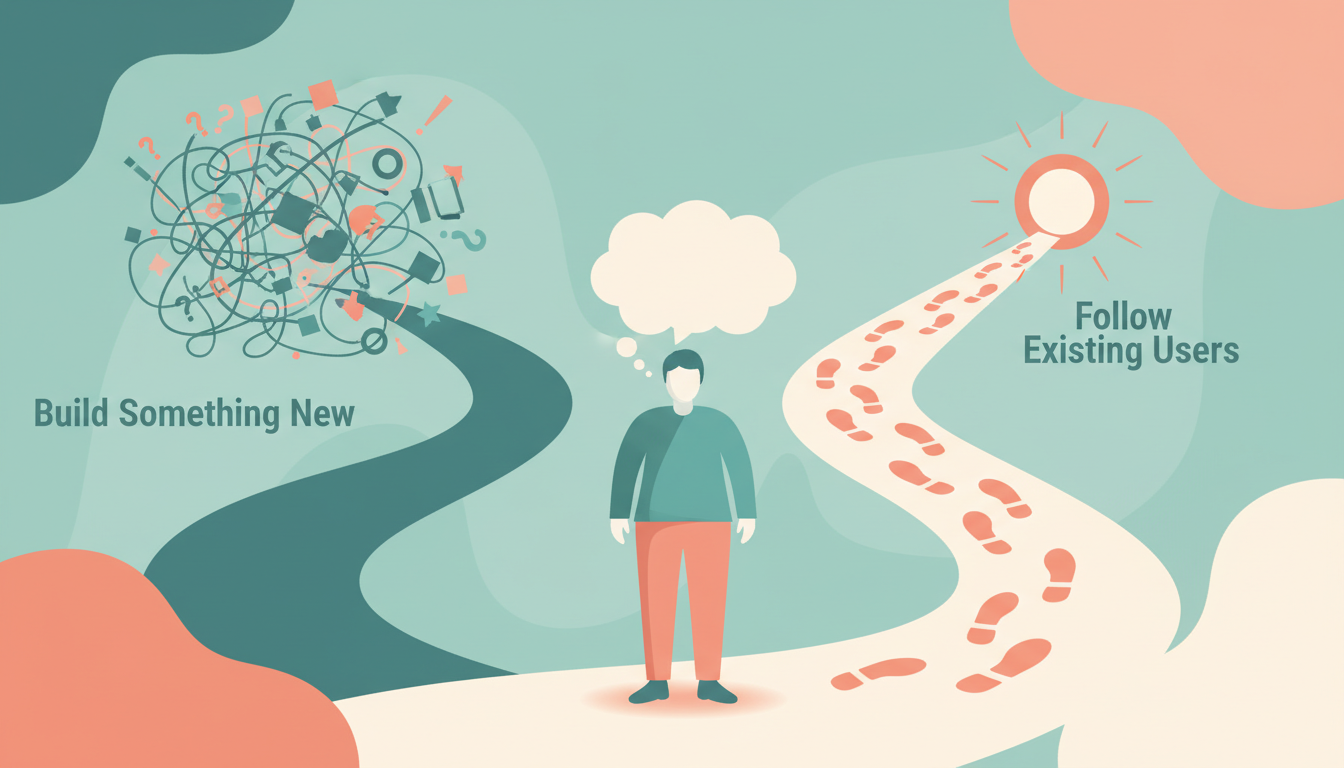
For years, I followed the standard advice: find a problem, build a solution, make something people want.
It sounds reasonable. It's also vague enough to be almost useless.
I'd come up with ideas that sounded good. Problems that seemed real. Solutions people should want. Then I'd build, launch, and watch the silence roll in.
The issue wasn't the ideas. It was the question I was asking.
The Wrong Question
"Is this a good idea?" leads you somewhere dangerous. It leads you to things that make sense on paper, things you can pitch convincingly, things that solve problems people will nod along to in conversation.
But nodding isn't buying. And "should want" isn't "will change my behavior to get."
That's where I kept getting stuck. I was asking people to change — to adopt a new workflow, try a new approach, add something to their routine.
Behavior change is brutally hard. People don't do it for marginal improvements. They barely do it for significant ones.
The Better Question
I came across a reframe recently from Paras Chopra that clicked:
Why would anyone change their behavior to accommodate your product?
The only honest answer: they wouldn't.
Unless they're already doing the thing, and you make it dramatically easier. As Chopra puts it, your product needs to make people "2x more efficient on a dimension they care about." Not 10% easier. Not "slightly more convenient."
The shift isn't from "no behavior" to "new behavior." It's from "current behavior + friction" to "same behavior + way less friction."
What This Looks Like in Practice
I'm building a design system generator right now. And when I check it against this filter, it holds up — not because design systems are a clever idea, but because designers are already building them.
They're already creating color tokens manually. Already copy-pasting spacing values. Already trying to keep Figma and code in sync. Already frustrated by the handoff.
I'm not convincing anyone that design systems matter. I'm showing up where the pain already lives and offering a faster path through it.
Same with the creative products I've launched — coloring books, activity books. People are already searching for these on Amazon. Already adding them to carts. Already buying.
I'm not changing behavior. I'm intercepting it.
The 2x Test
Now, before I commit to building anything, I ask:
- What specific behavior are people already doing?
- How are they doing it now?
- Can I make that at least 2x faster, easier, or better?
- Is that dimension something they actually care about?
If I can't answer all four, I don't have a product. I have a fantasy about behavior change.
The Trap of "People Should Want This"
The most dangerous ideas are the ones that feel obviously good. The ones where you can articulate the problem clearly and the solution seems elegant.
Because that clarity makes you confident. And confidence makes you build before you've verified the only thing that matters: are people already trying to do this?
If they're not, you're not building a product. You're building a persuasion problem. You're signing up to first convince people they have a problem, then convince them your solution is worth changing for.
That's two uphill battles before you've sold anything.
The Shortcut
The shortcut is to skip the first battle entirely.
Find people already in motion. Already frustrated. Already hacking together solutions. Already spending money on inferior alternatives.
Then make their existing path radically better.
That's not a sexy insight. It doesn't sound like innovation. But it's the difference between building something people politely appreciate and building something they actually use.
Nobody cares about your idea. Everyone cares about the thing they're already trying to do.
Meet them there.
This post was sparked by Paras Chopra's "Nobody cares about your idea." Short, sharp, worth a read.